Wednesday, November 27, 2013

New And Exclusive Micro-Site Content

ePHOTOzine's Micro-Site Roundup - Find out what's been happening on our five Micro-Sites.

Posted:

Here's a roundup of the exclusive content we've got for you to have a read of on our five micro-sites this week:

On PENTAXPORTAL this week, you can take a look at some top tips for photographing seals with your Pentax camera, and check out some top Pentax sunset photos. Plus, the brand new K-3 DSLR has been reviewed on site this week, and there's news of new images from Ricoh Imaging brand ambassadors.

Over On EIZO ColorZone, you can learn how to perform a monitor viewing angle check and find out why ColorNavigator software is a great tool for aiding calibration. Plus, there's news of a new 3D CG colour management handbook that's now available.

Meanwhile, on Olympus Image Space this week, there are techniques on how to use blur creatively, and there's news on Olympus workshops taking place over the coming months with Damian McGillicuddy and Steve Gosling. Plus, news on the Olympus Impressions 'Fall' competition, and £100 accessory cashback when you buy an Olympus OM-D E-M1 camera have also gone live.

On Totally Tamron this week, you can learn some top tips for taking better photos of ice with your Tamron lens, plus there are some top Tamron portrait photos for you to take a look at. Don't forget to take a look at David Pritchard's blog the days zoom past, too, as he's been out-and-about with his newly acquired Tamron 24-70mm lens.

Last but not least, on Nikon Nation this week, you can check out some ideas and tips for on location portrait shoots, get creative with colour balance and lots more. Plus, don't miss the Nikon D5300 Cheap DSLR review and news of ono-to one training with Nikon School in December.

Make sure you check back to the Micro-Sites regularly, as new and exclusive content is posted weekly!


Source: Ephotozine

Saturday, November 23, 2013

New And Exclusive Micro-Site Content

ePHOTOzine's Micro-Site Roundup - Find out what's been happening on our five Micro-Sites.

Posted:

Here's a roundup of the exclusive content we've got for you to have a read of on our five micro-sites this week:

On PENTAXPORTAL this week, you can take a look at some top tips for photographing seals with your Pentax camera, and check out some top Pentax sunset photos. Plus, the brand new K-3 DSLR has been reviewed on site this week, and there's news of new images from Ricoh Imaging brand ambassadors.

Over On EIZO ColorZone, you can learn how to perform a monitor viewing angle check and find out why ColorNavigator software is a great tool for aiding calibration. Plus, there's news of a new 3D CG colour management handbook that's now available.

Meanwhile, on Olympus Image Space this week, there are techniques on how to use blur creatively, and there's news on Olympus workshops taking place over the coming months with Damian McGillicuddy and Steve Gosling. Plus, news on the Olympus Impressions 'Fall' competition, and £100 accessory cashback when you buy an Olympus OM-D E-M1 camera have also gone live.

On Totally Tamron this week, you can learn some top tips for taking better photos of ice with your Tamron lens, plus there are some top Tamron portrait photos for you to take a look at. Don't forget to take a look at David Pritchard's blog the days zoom past, too, as he's been out-and-about with his newly acquired Tamron 24-70mm lens.

Last but not least, on Nikon Nation this week, you can check out some ideas and tips for on location portrait shoots, get creative with colour balance and lots more. Plus, don't miss the Nikon D5300 Cyber Monday Deal DSLR review and news of ono-to one training with Nikon School in December.

Make sure you check back to the Micro-Sites regularly, as new and exclusive content is posted weekly!


Source: Ephotozine

Saturday, November 16, 2013

Nikon P7800 review

<Nikon D5300 Cheapp>

What is the Nikon P7800?

Nikon's advanced compact offering has long taken the form of the Coolpix 'P' series, with the four-digit range sitting at the top and looking to offer a suitable companion to it's DSLR range for those wanting at times to travel light. The Nikon P7800 is the latest model that looks to build on the success of the previous models in the series with a range of new features and take on the Canon G16.

But, with the growth of the advanced compact market, as well as the drop in price of competing CSCs, the question is does the P7800 remain a relevant shooting proposition, or has technological advancement rendered it obsolete?

SEE ALSO: 10 best cameras you can buy


Nikon P7800: Features

One of the core features that has made the high-end P series a success in previous generations is the fact that it features a larger sensor than is normally found in a compact, and the P7800 retains this selling point.

The P7800 retains the same 12.2MP BSI CMOS sensor as seen in the P7700, which measures in at 1/1.7-inches, as opposed to the smaller 1/2.3-inch sensor. The P7800's BSI sensor should handle noise better then the equivalent sensor technology, although it only has a native ISO 80-1600 - extendible to ISO 3200 and 6400.

Another feature maintained from the previous generation model is the 3-inch, 921k-dot LCD screen which, thanks to a side-mounted hinge, can be rotated around a 270 degree axis for viewing at a variety of angles.

SEE ALSO: 10 best DSLR cameras you can buy

The Nikon P7800 also retains the same 7.1x optical zoom as seen on the model's predecessor, covering an equivalent focal range of 28-200mm and offering an impressive maximum aperture between f/2 and f/4.

One of the standout new additions to the Nikon P7800 is sure to be popular amongst some enthusiast photographers. It now features a relatively substantial electronic viewfinder that measures in at 0.5-inches, has a resolution of 921k-dots and also features a dioptre adjustment.

Another notable feature is the Nikon video capture functionality that's better than some competing models. The P7800 captures full HD video at 1920 x 1080 and at 30fps, while advanced functionality such as wind noise reduction, in-built ND filter and manual exposure control also feature.

While there's no doubting the P7800's positioning as an advanced compact - as shown through the inclusion of PASM shooting modes - it also caters for those that might want to let the camera do the work.

It does so through the presence of an auto shooting mode, a range of scene modes and a host of creative 'Effects' such as 'Cross Process' and 'Zoom Exposure'.

One feature which is sorely missed, owing to the fact that it's now commonplace on competing cameras, is Wi-Fi functionality. Both Wi-Fi and GPS tagging are available with the P7800 although only through the purchase of optional accessories.


Source: Trustedreviews

Sunday, November 10, 2013

Nikon Releases D5300 Digital SLR Camera

<Nikon D5300 Buy Cheapp>/PRNewswire/ --

The new Nikon D5300 with built-in Wi-Fi® and GPS makes it simple to share high quality images

Nikon Singapore Pte Ltd is pleased to announce the release of the D5300, Nikon's latest entry-level DX-format digital SLR camera.

(Photo: http://photos.prnewswire.com/prnh/20131110/652912 )

The D5300 offers an effective pixel count of 24.2-million pixels and is equipped with a Nikon DX-format CMOS sensor with no optical low-pass filter, as well as the new high-performance EXPEED 4 image-processing engine. It is Nikon's first digital SLR camera to offer built-in wireless LAN (Wi-Fi®) and GPS functions, so users can easily share high-quality images captured with the D5300 and NIKKOR lenses via a smart device. These functions also allow users to look back on routes taken on vacation or with outdoor activities using a log feature that is part of the built-in GPS function.

The D5300 is designed with a structure made of a new material to bring about a smaller and lighter body while maintaining the necessary strength and durability. The camera is also equipped with a number of features that support various shooting situations, including a 3.2-inch, approximately 1037k-dot vari-angle monitor with a wide viewing angle for shooting from a variety of angles, a full-HD movie recording function that supports recording of smooth 1920 × 1080/60p movies, and a Special Effects mode with nine options that can be applied to photos and movies with shooting for a variety of creative effects.

The Zoom/Focus Assist Lever NAL-1 for exclusive use with NIKKOR lenses will also be released at the same time as the D5300. The NAL-1 is a lever that enables smoother zooming and focusing when attached to the zoom ring or focus ring on a NIKKOR lens and is especially convenient for movie recording.

D5300 Primary Features

1. An effective pixel count of 24.2-million pixels anda Nikon DX-format CMOS sensor with no optical low-pass filter, and the latest image-processing engine, EXPEED 4, for superior image quality and definition

The D5300 offers an effective pixel count of 24.2-million pixels and is equipped with a DX-format CMOS image sensor developed exclusively by Nikon. It supports a broad range of standard sensitivities from ISO 100 to 12800, as well as an additional expansion of up to ISO 25600 equivalent (Hi 1) for high-definition images exhibiting very little noise with shooting at a broad range of sensitivities. In addition, the high-speed performance of the latest image-processing engine, EXPEED 4, optimized for high-performance digital SLR cameras, provides superior results with noise reduction (NR), auto white balance, color reproduction characteristics, tone processing, and image quality at high sensitivities. The absence of a low-pass filter maximizes the superior resolution of the high pixel count and rendering capabilities of NIKKOR lenses.

2. Built-in Wi-Fi for transferring high-quality images to a smart device for ease of sharing

As Nikon's first digital SLR camera equipped with a built-in Wi-Fi function, high-quality images with an effective pixel count of 24.2-million pixels captured from a variety of angles using the flexible vari-angle monitor can be transferred to a smart device for sharing with others[*1]. This expands the ways in which images are enjoyed after they are taken by enabling immediate image transfer for sharing photos with family and friends via blogs or social networking sites anytime, anywhere.

    Transfer function: Images captured by the D5300, or already saved to a memory card inserted in the D5300, can be transferred to a smart device over a wireless connection. These images can then be viewed in the smart device display, or uploaded to a blog or social networking site. In addition, the size at which images are transferred to a smart device can be selected from two options to fit the storage capacity of the smart device.
    Remote shooting function: The camera's live view shooting display can be shown on the display of the smart device in real time, allowing users to accurately frame photos and predict results with remote control while shooting[*2].
    Manual upload function: Users can select images to be uploaded to a smart device using the D5300 monitor display. In situations or environments that do not sufficiently support immediate image upload, or when a smart device is not readily available, the camera can be used to specify images, and image file size, to be uploaded to the smart device at a later time.

[*1] The Wireless Mobile Utility app must first be installed on the smart device (the app can be downloaded free of charge from the smart device's app store).

[*2] Effective only when AF-area mode is set to "Normal-area AF" or "Wide-area AF".

3. A built-in GPS function that records location data and tracks movement

The D5300 is Nikon's first digital SLR camera with a built-in GPS function, enabling recording of location data (longitude, latitude, altitude) with images. It also works seamlessly with ViewNX 2, NIKON IMAGE SPACE, and commercial mapping software enables display of images where they were captured on maps, as well as sharing of images with location data. The A-GPS function also makes detection of location data smoother. This capability allows users to look back on memories or track their movement, on vacations or with outdoor activities by shooting location, and date and time of capture.

4. Designed using a new material for a smaller and lighter body that is strong and durable

The D5300 is designed using a new material. As the camera cover and body are formed with a rigid, integrated structure, there are fewer joints. This enables a smaller and lighter camera with a width of 125 mm, height of 98 mm, and depth of 76 mm, and weighing just 530 g[*], all while maintaining the necessary strength and durability.

* Including battery and SD memory card; excluding body cap.

5. A 3.2-inch, 1037k-dot vari-angle LCD monitor with wide viewing angle for simple shooting from any angle

The D5300 features a larger 3.2-inch (approximately 1037k-dot) LCD monitor with wide viewing angle for a crisp and clear display. The side-hinged vari-angle monitor opens from 0 to 180° at the side, and can be rotated up to 90° clockwise and up to 180° counter-clockwise. This enables shooting from a wide variety of angles, from low to high, making even self-portraits possible.

6. D-Movie function for recording full-HD 1920 × 1080 60p movies

The D5300 is equipped with a D-Movie function that supports recording of 1920 × 1080/60p movies. The combination of NIKKOR lenses, a high pixel-count CMOS image sensor unit which does not include an optical low-pass filter, and an effective pixel count of 24.2-million pixels, enables recording of high-definition movies exhibiting superior rendering characteristics. In addition, autofocusing during movie recording is possible using contrast-detect AF. When the focus mode is set to full-time-servo AF (AF-F) and AF-area mode is set to Subject-tracking AF, the camera automatically maintains focus on moving subjects. Manual movie settings are also available, allowing users to choose the desired shutter speed and ISO sensitivity in live view mode and with movie recording. Movie frame rate with full-HD recording can be selected from 24p, 25p, 30p, 50p, and 60p. In addition to recording of high-quality sound via the built-in stereo microphone, the optional Stereo Microphone ME-1 can also be used to record stereo sound.

    Toy Camera Effect: Create photos and movies in which colors have been changed and edges have been shaded so that they appear to have been recorded with a toy camera. Users can adjust the vividness and degree of vignetting (peripheral shading) from three options each to suit their individual preferences.
    HDR Painting[*]: The camera shoots two frames at different exposures and combines them, with processing that changes color tones, for HDR images with a painterly effect.

7. Toy Camera Effect and HDR Painting added to Special Effects mode (total of 9 effects) for more creative expression with still images and movies

The D5300 is equipped with a Special Effects mode, with which effects can be selected and applied with recording of both still images and movies. The effects can also be previewed in the camera monitor in real time before shooting or recording begins. A total of nine special effects are available, including the seven built into the D5200 (Selective Color, Color Sketch, Miniature Effect, Night Vision, Silhouette, High Key, Low Key), as well as the new Toy Camera Effect and HDR Painting*. This allows users to easily utilize dramatic effects like those seen in art and the movies. This mode was incorporated into the D5300 to respond to the creative intent of users who were searching for a way to express their own unique style and creativity.

* HDR Painting cannot be applied to movies. Further, results of the HDR Painting effect cannot be previewed in the camera monitor.

8. Designed with a firm grip using just one hand and available in 3 colors, including a new gray option

The grip on the D5300 is designed to fit comfortably in the palm of the hand for a firm hold using just one hand, making framing via both the optical viewfinder and the monitor's live view display easier. In addition to the popular black and red colors, the D5300 is also available in a new gray option. Metal parts on the D5300, such as the microphone cover and plate over the mode dial, have also been designed with a surface finish that gives the camera an elegant appearance.

About Nikon

Pricing and Availability

The Nikon 5300 will be available in three colors (Black, Red and Gray), starting in November 2013 at the suggested retail price (SRP) of AED 3,999. For more information on the new Nikon D5300 and other Nikon products, please visit http://www.nikon-mea.com.

Nikon, At the Heart of the Image. Nikon is the world leader in digital imaging, precision optics and photo imaging technology and is globally recognised for setting new standards in product design and performance for its award-winning consumer and professional photographic equipment. Nikon Singapore Pte Ltd distributes consumer and professional digital SLR cameras, NKKOR optics, Speedlights and system accessories; Nikon COOLPIX compact digital cameras; Nikon sports optics as well as the Nikon 1 advanced cameras with interchangeable lens system in over 50 countries.

For more information, visit http://www.nikon-mea.com. Connect with Nikon and other photographers on Facebook at http://www.facebook.com/NikonMEA and get the latest news and information from Twitter by following @NikonMEA.

SOURCE Nikon Corporation

* Read more articles by Nikon Corporation


Source: Sacbee

Thursday, November 7, 2013

Nikon D5300 hands-on review

Nikon Nikon D5300 Coupons at a glance:

  • 24.2-million-pixel, APS-C-sized CMOS sensor
  • 1.037-million-dot, 3.2in, 170° LCD screen
  • Expeed 4 image processor
  • 39-point AF system with nine cross-type sensors
  • ISO 100-25,600
  • Price £730 body only

Nikon D5300 - Introduction

While the serious enthusiast is unlikely to be swayed into buying a Nikon DSLR over a Canon model purely because the Nikon camera is newer, the reality is that at the non-premium end of the market this is how some people make their buying decisions. 'Newer' must mean 'better'.

This demand for the 'new' explains why we see such short product cycles in the camera market, and why manufacturers feel the need to introduce even small advances in technology or feature sets in cameras with completely new names - rather than a 'Mark II' type of naming format.

Those familiar with Nikon's range of DSLRs may not see the sense in the company's introduction of the new D5300, especially as Nikon will maintain the D5200 alongside this model in the range - new and old together. By doing so, though, Nikon expands the number of cameras it has on offer and the number of price points it can cover, while also being able to have a model that can carry a 'New' sticker, and which introduces new features to the price band in which it will sit.

That's not to say that the Nikon D5300 isn't different to the D5200, though, as a new processor, new body design and the integration of wireless communications do genuinely bring additional benefits to the photographer.

Nikon D5300 - Design and handling

Nikon is very pleased that it has achieved a new way of constructing camera bodies, which it describes as a 'monocoque'. Instead of there being a chassis, onto which the components and the body shell are attached, the D5300 is designed to have everything screwed to the insides of the body form itself: exoskeleton, rather then the usual endoskeleton.

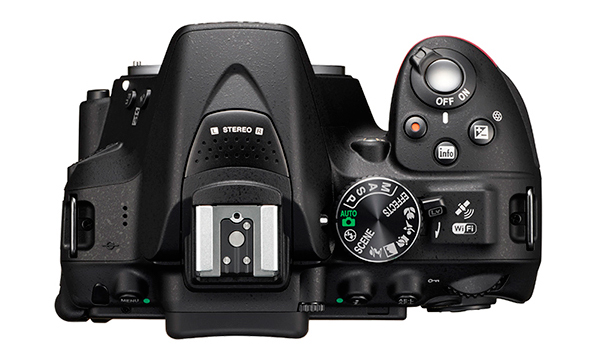
Image: The top of the camera houses only a few control points, keeping the layout simple and unintimidating for newcomers. A stereo microphone lives in front of the hotshoe
The D5300's body shell is also made of a new material, although Nikon won't say what that new material is - just that it is new. The upshot is that the body is less heavy than it might have been, and is 25g lighter, including the battery, than the camera it doesn't replace, the D5200.

I'm not entirely sure that when I used the camera I could appreciate the exact weight loss that has occurred, but I was able to enjoy the fact that this is truly a lightweight DSLR, of the type that we might not mind carrying all day, over the shoulder, in a bag or in a large pocket. The body is very small too, although it is balanced with a reassuringly large grip for the right hand. It seems ironic that a small and light camera should need a large grip, but I found it allowed me to be aware I was carrying the camera, and should a larger lens be attached it will help to support the forward pull of such a weight distribution.

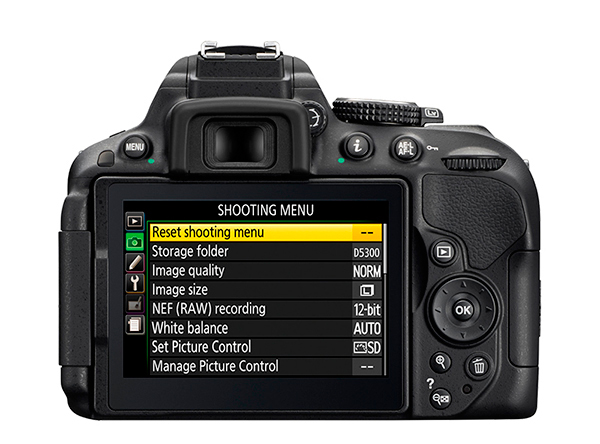
Image: The body styling will be familiar to those used to the Nikon 5000 series, as will the standard menu. The 3.2in flip-out screen has impressive visibility
The buttons are arranged much as one might expect, with all the principal controls falling easily to the finger or thumb. The rear 3.2in LCD is very nicely bright and clear, with its 1.037-million-dot resolution. Nikon has set the viewing panel into the glass screen, so there are no gaps or internal reflections, which produces good contrast and a clear view from a quoted angled of up to 170°. I am impressed.

In live view, the screen works well when the camera is held low or high, and I found the AF quick enough and seemingly accurate. The response of the shutter in live view also seems good.

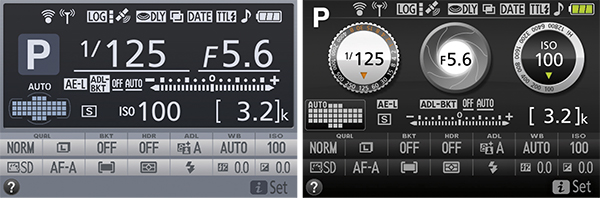
Image: Nikon has retained its choice of layouts for the rear-screen display, with text-based and graphically expressed options to suit personal preferences
Nikon D5300 - Still to test

The principal changes in this model are of the sort that will only be proved in testing, but at this stage their potential is worth pointing out. Using the higher-capacity Expeed 4 processor, Nikon claims it has been able to reduce noise in its images through the use of more complicated calculations. A related benefit is that now noise levels are lower the company is comfortable offering a higher ISO setting - the Nikon D5300 allows ratings of up to ISO 25,600. More complex calculations also provide the potential for better white balance assessment in automatic modes via a more comprehensive assessment of the scene, and a better rendition of colour overall.

Lower noise should also lead to better resolution of detail from the 24.2-million-pixel sensor, as should Nikon's decision to do without the micro-blurring effects of a low-pass (anti-aliasing) filter. Leaving the low-pass filter off the sensor has become very fashionable, and I suspect it will be a great draw for many photographers. Moiré in images created by a sensor with 24 million pixels, even an APS-C-sized sensor, is still something that is quite likely to occur, but there is also plenty of software to correct it after the event.

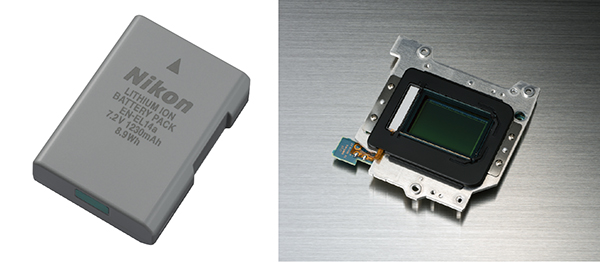
The other thing to note is that this model sees the introduction of a new battery cell, which Nikon says increases capacity from 500 shots to 600 compared to the cell used in the D5200. It annoys me when companies change their battery forms, but on this occasion the new cell and that used in the D5200 are interchangeable.

Obviously, I couldn't test the battery life of the camera, but we should take the increase as good news. I will also have to wait to test the Wi-Fi and GPS capabilities of this new model, but neither can be held as negative points just for their inclusion. The Wi-Fi integration means users will be able to control the camera from an Android or iOS device, and will be able to wirelessly transfer images for viewing, editing and sending while on the go.

Image: The new battery, which is backwards compatible with the D5200, offers a longer life. There is no low-pass filter on the sensor, for extra resolution

Nikon D5300 - Conclusion

It would be easy to dismiss the Nikon D5300 for being too similar to the D5200, but that really isn't the point. There is not much wrong with the D5200, and the changes that this new model brings can only make it better. Perhaps Nikon could have called it the D5200 ll, but I'm not sure it matters one bit.

The Nikon D5300 will cost around £730 body only and be available from 14 November.


Source: Amateurphotographer

Thursday, October 31, 2013

Nikon D5300 Digital SLR Wi-Fi Camera

Nikon D5300 Coupons.jpg">

Nikon just introduced the D5300 DSLR camera, which offers an enhanced 24.2-megapixel DX-format CMOS sensor, EXPEED 4 image processing, Vari-angle LCD, GPS and the convenience of built-in Wi-Fi. The mid-range SLR is compact and lightweight (16.9 oz.), and can easily be packed for a day trip or a planned getaway. The small body of the D5300 affords the photographer the freedom to travel while still being easy to handle and comfortable to use.

The D5300 is Nikon's first D-SLR to feature built-in Wi-Fi, allowing the user to share high quality photos instantly. The Nikon D5300 sends images to the user's smart device, allowing them to share their D-SLR quality photos through e-mail and social media. The Nikon D5300 also includes built-in GPS, another first for Nikon D-SLRs. Now the user can geotag images and allow others to see where life has taken them.

The enhanced 24.2-megapixel CMOS sensor delivers stunning images and HD videos with heightened clarity and detail due to the removal of the optical low pass filter (OLPF). Its 39-point high-density autofocus system with 9 cross-type sensors quickly locks onto your subject, and Nikon's unique 3D-tracking uses the 2,016-pixel RGB sensor to recognize and follow it across the frame.

Features:

  • Amazing Low Light Performance - For clean, sharp details even in the most challenging lighting conditions including night games and dimly lit restaurants, the Nikon D5300 covers a wide ISO range of 100-12,800 and is expandable to ISO 25,600.
  • EXPEED 4 Image Processing - Nikon's most recent image processing engine drives the rapid response and swift performance of the D5300, while maximizing energy efficiency, reducing image noise and delivering true-to-life colors.
  • Scene Recognition System - To further help users capture the image they intend, the Nikon D5300 features Nikon's Scene Recognition System and 2,016-pixel RGB metering system to analyze and recognize the scene. Utilizing these systems results in adjustments to exposure, AF and white balance to deliver the best photo possible, whether it's a landscape or portrait.
  • 39-Point AF System - Nikon's quick and precise 39-point AF system works with the Scene Recognition System to accurately acquire and track subjects throughout the frame, resulting in tack-sharp images. Kids too active to pose for a photo or pets chasing after a toy are easily captured in brilliant sharpness for memorable photos.
  • 5 Frames-Per-Second - While using the optical viewfinder or in Live View, capture great moments that would have otherwise been missed with the D5300′s 5 frames-per-second (fps) rate.
  • 3.2-inch Vari-Angle LCD monitor - Whether shooting above a crowd or getting low to capture the details of a flower, users can explore new shots from a dramatic point of view with the large 3.2-inch Vari-angle LCD monitor. This super sharp (1,037K-dot) screen allows photographers to easily make camera adjustments and read menus, while also allowing them to compose the photo they want clearly when shooting from high or low angles. The rotating LCD makes it easy to capture "selfies" at an arm's length away or frame creative perspectives when capturing still photos and HD video.
  • Full HD 1080p Video Capture - Create movies fit for the big screen with Full HD 1080p video capture at 60p with built-in stereo, wide ISO range for high quality videos in any light and improved full-time AF to keep the subject in focus.
  • NIKKOR Compatibility - The Nikon D5300 is compatible with Nikon's legendary NIKKOR lenses and powerful system accessories, further adding versatility and creativity.

Price and Availability
The Nikon D5300 kit with the AF-S DX NIKKOR 18-140mm f/3.5-5.6G ED VR lens will be available in October 2013 for$1,399.95. Available colors include Black, Red and Gray.


Source: Ecoustics

Tuesday, October 22, 2013

Nikon Unveils D5300 D-SLR With Wi-Fi

Nikon D5300 Discount-d5300.jpg?thumb=y">

Nikon didn't wait very long to update its excellent D5200 digital SLR. That camera, announced internationally last November, didn't make its U.S. debut until CES in January, and less than a year later we have its successor.

On the exterior the new D5300 is pretty much the same as its predecessor-the only notable change is an LCD that's a bit larger (3.2 inches) and sharper (1,037k dots) than the 3-inch, 921k-dot vari-angle display found on the D5200.

Despite boasting the same 24-megapixel resolution as its predecessor, the D5300's image sensor is a different design. It's the same one that is found in the D7100. That means that it omits the optical low-pass filter (OLPF). Professional medium format digital cameras have long done away with the OLPF, which saps up a bit of detail in order to eliminate the possibility of color moire appearing in images. Over the past couple years, more and more smaller format cameras have dropped the OLPF, including Nikon's own D800E and the Pentax K-5 IIs. But the D5300 is the first camera we've seen that is squarely aimed at the consumer market to take this approach.

The EXPEED 4 image processor is also new to the D5300, replacing the EXPEED 3 chip that powered the D5200. This is the first Nikon camera with this image processor, but the company promises that it will deliver improved performance in low light and faster operation overall. The native ISO range is ISO 100 through 12800, with 25600 available as an expanded option. The metering and focus systems are the same as the D5200-that gives the camera a 2,016-pixel RGB sensor for scene recognition and 39 selectable autofocus. Like its predecessor, the D5300 is rated to shoot at 5 frames per second.

The other big internal upgrade is the addition of built-in Wi-Fi. Previously Nikon D-SLR owners had to purchase the WU-1a adapter to add wireless connectivity to their cameras. This feature is built into the D5300, so you can transfer photos wirelessly to an iOS or Android device without the need for an add-on. A GPS module is also built into the camera, so your location is added to photo metadata automatically. You'll be able to look at shots on a map when using software like iPhoto or Picasa, or sharing online via a hosting service that includes a map view, like Smugmug.

The D5300 will be available in black, red, or dark gray. It's priced at $799.95 as a body only, or $1,099.95 with an 18-140mm lens. It will be available to purchase in mid-November.

This announcement comes on the heels of news of the D610, a very minor update to the full-frame D600. It's essentially the same camera, but with an improved shutter that allows for a 6fps continuous shooting rate. Many D600 owners reported that the camera has a tendency to pick up dust on the sensor after extended use. It wasn't something we saw with our review unit, and sensor dust is a common issue with all interchangeable lens cameras, but the noise that D600 owners made indicated that it was something beyond what is normally expected.

Nikon issued a service advisory for the D600 relating to the dust issue. The company is not saying that the new shutter is there to reduce the instances of dust accumulation; rather, the official line is that it improves the burst shooting rate and also introduces a new 3fps quiet continuous mode.

The D610 comes in at a $100 less than its predecessor; it's priced at $1,999.95 as a body only, and can be purchased in a kit with the 24-85mm f/3.5-4.5 lens for $2,599.95.

Rounding out the Nikon announcements is a new high-end prime lens. The AF-S Nikkor 58mm f/1.4G matches the focal length of the classic Noct-Nikkor 58mm f/1.2, but its aperture isn't quite as ambitious. The new lens features the latest nanocrystal coatings, ED and aspherical elements, and an internal SWM focus motor. It's priced at $1,699.95 and will be available at the end of October.


Source: Pcmag